


Legacy Modernization with AI for Insurers and Financial Service Providers
Automation Through Artificial Intelligence
Understanding, Documenting, and Modernizing Legacy Systems for the Future

Insurers and financial service providers are under immense pressure to digitize. Outdated legacy systems hinder innovation, increase operating costs, and jeopardize regulatory compliance. Maintaining such systems is expensive, error-prone, and dependent on a small number of experts—a risk that is becoming even more acute given the shortage of skilled workers. In addition, incomplete or missing documentation increases the effort required for modernization and hinders knowledge transfer.
The demands placed on companies are constantly increasing. In addition to complying with DORA and meeting BaFin reporting requirements on time, companies are expected to respond ever more quickly to market changes. At the same time, customers’ expectations for digital services are rising; these services are expected to be not only reliable but also intuitive and innovative.
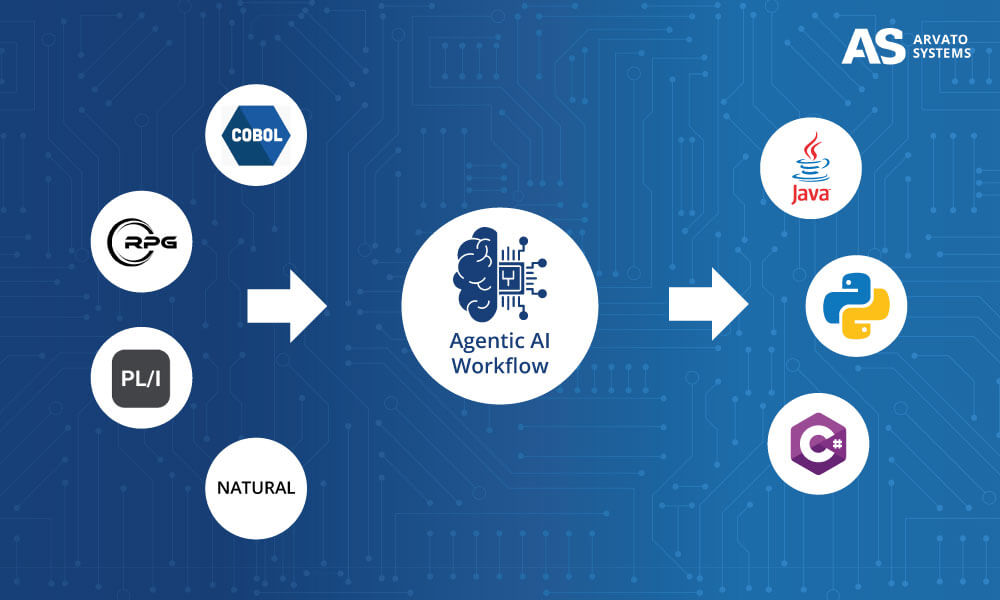
The industry needs reliable and scalable solutions to modernize its legacy systems. This is exactly where our AI-based code modernization comes in: It translates legacy code written in COBOL, NATURAL, PL/I, or RPG into modern languages such as Java, Python, or C#—automatically, transparently, and quickly for testing.
Our Solutions for Modernizing Your Legacy Systems
-
Modernization of Legacy Systems
Outdated legacy systems hinder innovation and tie up valuable resources. Arvato Systems modernizes your legacy applications using AI-powered software development—efficiently, with minimal risk, and without any loss of functionality. We analyze, document, and migrate existing code into modern languages.
-
AI-powered software documentation – automated & multilingual
Missing or outdated documentation jeopardizes knowledge transfer for critical applications. Our AI-powered process quickly generates automated, multilingual code documentation—complete, up-to-date, and preserving key technical terms. This allows you to safeguard your expertise and accelerate knowledge transfer.
-
InsaCore – Your Core Systems, Reimagined
InsaCore is the future-proof framework for composite core systems that allows you to modernize your existing platform incrementally and without the need for a time-consuming reimplementation. Proven business logic is preserved while technical infrastructure is upgraded to industry standards—with predictable costs, low risk, and rapid value creation. The modular structure—comprising InsaPolicy (portfolio and contract management), InsaClaims (claims management), InsaBilling (incoming and outgoing payments), and InsaInsight (insight management and process improvement)—covers all core processes. This allows you to start exactly where your needs are greatest—flexibly, seamlessly integrated, and future-proof.
The Benefits of AI-Based Modernization of Legacy Systems

The AI-driven modernization approach for legacy systems delivers reliable results with significantly reduced effort. It enables the rapid and low-risk migration of complex legacy systems to a future-proof technological foundation while accelerating the ongoing transformation of the application landscape.



Success Stories


Arvato Systems supports insurance companies, banks, and financial service providers in the secure operation of complex IT landscapes. Regulatorily compliant operating models, cloud and data center environments, and extensive experience with security, compliance, and business-critical applications form the foundation for reliable and resilient IT services.
Frequently Asked Questions About AI-Based Modernization of Legacy Systems
-
What does automated legacy modernization with Agentic AI Workflows mean?
In legacy modernization with Agentic AI, AI agents automatically analyze and modernize legacy code. This AI-powered code transformation significantly accelerates the replacement of outdated systems and delivers transparent, traceable results. This allows companies to maintain control over the modernization process at all times.
-
In which programming language is the modernized code available after the transformation?
The modernized code is fully compilable and implemented in a current, future-proof programming language. It provides a robust foundation for operation, further development, and integration into existing system landscapes. This enables companies to solve typical problems associated with legacy systems, such as a shortage of skilled personnel for outdated technologies and high maintenance costs.
-
Will existing JCL structures and batch processing be taken into account during the modernization?
Existing JCL (Job Control Language) structures are specifically taken into account and modernized. Batch processing and control logic are seamlessly migrated to the new architecture—without any loss of functionality. This step is crucial for a low-risk transformation, especially for legacy mainframe and COBOL applications.
-
How are outdated user interfaces replaced as part of the modernization process?
Outdated user interfaces are being replaced by modern web UIs, such as those based on Angular. This UI migration ensures better usability, higher user acceptance, and a modern, responsive user experience.
-
How is the existing application logic validated during unit testing?
Automatically generated unit tests validate the existing business logic of the applications and build confidence in the new codebase. Among other things, unit testing ensures that the original functionality is preserved.
-
Will technical documentation also be created during the modernization?
Structured technical documentation is being developed in parallel with the modernization effort. It creates transparency and serves as a solid foundation for further steps in the transformation process. This ensures that knowledge about the application is preserved and remains available regardless of individual specialists.
-
How does Kubernetes ensure reliable and scalable operation?
Kubernetes provides the technological foundation for sovereign, scalable cloud operations of modernized applications—regardless of the chosen hosting approach. Through container orchestration, applications can be flexibly operated in the cloud, on-premises, or in a hybrid environment, thereby contributing to digital sovereignty.
-
Is the legacy transformation carried out in one big step or iteratively?
Modernization takes place iteratively and incrementally rather than in a “big bang.” This approach minimizes risks, safeguards ongoing operations, and makes the initial benefits visible early on. Especially with complex legacy systems, the iterative approach significantly reduces the risk of functionality loss.
-
How does Arvato Systems support AI-driven application modernization for legacy systems?
Arvato Systems helps banks, insurance companies, and financial service providers better understand legacy systems through AI-powered application documentation and modernize them in a targeted manner. The goal is to reduce technical dependencies, simplify maintenance, and ensure the ability to innovate.
Your Contact for AI-Based Modernization
