


SAP EWM for Scalable Warehouse Processes
Cloud-Based Inventory Management for Consumer Goods
Key Points at a Glance
The fictional consumer goods manufacturer Nordlicht Imaging continues to grow. New distribution channels, rising order volumes, and additional warehouse locations are increasing the demands for transparency and controllability. In this article, we’ll show how SAP Warehouse Management and SAP EWM in the public cloud standardize warehouse processes, provide transparency into inventory, and support further growth.
When Warehouse Logistics Become a Bottleneck in the Consumer Goods Industry
A year ago, the situation at Nordlicht Imaging was still manageable. Warehouse logistics consisted of a single central location, a limited number of product variants, and predictable fluctuations in order volume. But the business has changed since then.
The first post in this series showed: The successful implementation of SAP Cloud ERP has led to greater transparency in purchasing, sales, and production. At the same time, order volumes in the company’s own online store and through international retail partners are rising steadily. New product lines, additional accessories, and seasonal peaks such as Black Friday mean that significantly more goods movements must be processed every day.
In the warehouse, it quickly becomes clear where growth hits its limits:
- Employees look for the correct storage locations.
- Although items are in stock, they are not always immediately available.
- Picking orders is taking longer than planned.
- Priorities between trading partners and the end-customer business must be continuously adjusted.
- Additional shipping providers and shipping methods increase the complexity.
It has become clear to Nordlicht that transparent ERP processes alone are not enough. Operational warehouse logistics also require a scalable platform.
Why Inventory Management Processes Determine Growth
Many companies initially invest in ERP systems, digital sales channels, or automation.
However, the impact of growth on warehouse processes is often underestimated.
At Nordlicht Imaging, hundreds of additional inventory movements take place every day:
- Goods Received from International Suppliers
- Inventory transfers within the warehouse
- Shipping of Promotional Items
- E-commerce Returns
- Replenishment for High-Speed Runners
Without clear processes, search times, inventory discrepancies, and unnecessary follow-up questions arise.
For growing consumer goods companies in particular, the quality of warehouse processes is therefore a key factor in determining delivery capability, customer satisfaction, and cost trends.
What is SAP Cloud WM, or SAP Warehouse Management?
SAP Cloud WM is a warehouse management solution that extends the logistics functions available in SAP Cloud ERP with professional warehouse processes. At the core of Cloud WM is SAP Extended Warehouse Management (SAP EWM), implemented as an integrated, embedded version—also known as Embedded EWM. Cloud WM has also been simplified without limiting any essential core functions for mapping logistics processes. All warehouse movements are planned, controlled, and monitored using a common database. SAP Cloud WM thus brings structure to warehouse logistics. For Nordlicht Imaging, this means specifically:
Transparent Holdings
Employees can see at any time:
- where products are located,
- what quality status they have,
- for which orders inventory is reserved,
- which quantities have already been scheduled for shipment.
Guided Bearing Processes
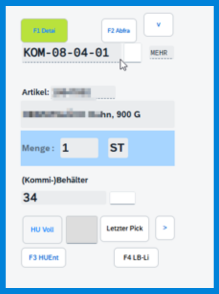
Instead of paper-based processes, warehouse employees receive their tasks directly on their mobile devices.
The system guides you through:
- Goods Received
- Storage
- Replenishment
- Order Picking
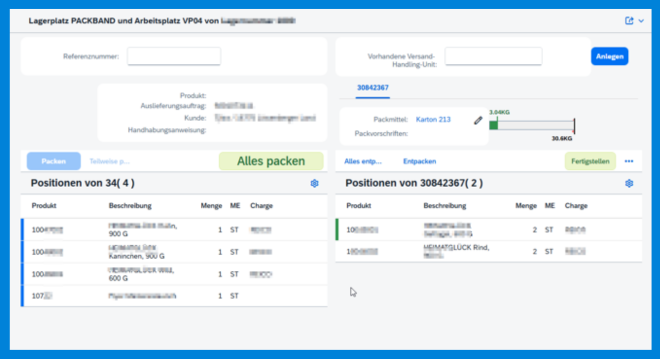
- Packaging
- Shipping
This reduces errors and helps new employees become productive more quickly.
Optimized Order Picking
Especially as e-commerce business grows, the speed of order processing plays a key role. SAP Cloud WM, for example, supports:
- Multi-Order Picking
- Wave Formation
- Pick-by-Area Concepts
- Route Optimization
- Integration into Production and Packaging Processes
This allows the same team to handle more orders.
And if the warehouse staff is insufficient during peak order periods—no problem: thanks to the intuitively designed screens on mobile devices, the training period is very short, so that, for example, external warehouse staff can become productive very quickly.
Common Customer Issues
- Different carrier requirements: Each package delivery service expects its own specific information, services, and formats. Shipping data from SAP must be transferred in the appropriate format, and responses must be mapped back to the correct fields.
- Media breaks in shipping: Employees switch between SAP, carrier portals, and separate shipping programs. This takes time and increases the likelihood of data entry errors.
- Labels and Confirmations: Shipping labels, tracking numbers, and status updates must be fed back into the warehouse process to ensure that shipping and tracking remain traceable.
- Cloud Requirements: The integration must be compatible with the available API and extension architecture. SAP documents APIs for delivery and transport processes; the specific scope of the processes depends on the product and release.
However, integrating a C&E service provider must also accommodate its specific requirements for shipping data and feedback. Our solution connects the SAP Cloud WM process with the CEP service providers and feeds the relevant shipping information back into the SAP process—all within the Clean Core and using upgradeable and extensible interfaces via SAP BTP.
What Are the Benefits of SAP EWM in the Public Cloud?
Many companies still associate the public cloud with limited functionality.
The reality is increasingly different. Using a public cloud does not mean doing without professional warehouse logistics.
With SAP S/4HANA Cloud Public Edition now offers powerful warehouse management functions that are specifically designed for standardized and scalable processes.
This offers several advantages for Nordlicht Imaging:
- Faster Implementation
Preconfigured processes significantly reduce implementation time. - Regular Innovations
SAP continuously releases new features. - Unified Data Base
ERP and warehouse processes use the same business data. - Less technical complexity
SAP manages the platform, which reduces the burden on internal IT resources.
When Cloud WM and Warehouse Automation Work Together
Many projects show that companies want to establish standardized cloud processes first before implementing further levels of automation.
This is precisely where a key advantage of modern warehouse management solutions lies: companies can grow gradually. Nordlicht, for example, starts with:
- transparent inventory levels,
- mobile warehousing processes,
- efficient order picking,
- standardized goods receipts.
Additional features can be added later:
- Warehouse Automation
- Conveyor System Integration
- Yard Management
- Slotting
- Resource Management
- Robotics
To connect external automation and robotic systems, Cloud WM provides a range of interfaces (APIs) that allow these external systems to be easily and seamlessly integrated into warehouse processes. This creates a logistics platform that can grow with the company.
Logistics as Part of the SAP Business Suite
For Nordlicht Imaging, warehouse logistics is not an isolated process.
It is closely linked to purchasing, sales, production, and customer service.
Only the integration of the SAP Business Suite enables end-to-end processes:
- SAP Cloud ERP manages the core processes.
- SAP Cloud WM manages warehouse logistics.
- SAP Commerce Cloud connects customers and retail partners.
- SAP Business Technology Platform integrates additional applications and partner solutions.
This results in end-to-end processes, from order placement to delivery.
What Advantages Does Sap Ewm Offer Consumer Goods Companies?
Many companies initially respond to increasing demands by expanding their warehouse space or hiring more employees. But growth doesn’t require larger warehouses—it requires better processes. Often, however, significant added value can be achieved simply through transparent processes, digital warehouse management, and standardized procedures.
For companies in the consumer goods industry, such as Nordlicht Imaging, this means:
SAP Cloud WM thus lays the foundation for managing rising order volumes without allowing complexity to increase at the same rate.
Here’s How the Blog Series Continues
In the next post, we'll take a look at the next stage of development for the fictional consumer goods manufacturer Nordlicht Imaging: SAP Commerce Cloud supports employees with recurring tasks, analyses, and decisions. We’ll show which use cases are already realistic today and what prerequisites need to be established to make them possible.
Getting Started with the SAP Quick Check
Where do most inquiries and manual handoffs occur in your company? In Arvato Systems’ SAP Quick Check, we assess your current situation during a one-day workshop at a fixed price. Together, we develop an initial target vision and map out your existing application landscape, including connected systems.
For existing SAP systems, we incorporate the licensing situation and any available readiness check results into our initial assessment. To prepare, please provide an overview of your applications as well as the available SAP licensing and readiness documentation. You’ll receive guidance for your SAP transformation and the subsequent detailed planning.
Request an SAP Quick Check now and let’s prepare for your next step in growth together.


Written by
