

Terminology Management: Consistent Language as a Key to Success
The Foundation for Documentation, Translation, and AI
Few industries are as heavily influenced by technical jargon as IT. When technical teams, support staff, and management use different terms to refer to the same things, it costs time and money. Terminology management creates clarity. With automation and AI, consistent IT terminology becomes a real business driver.
What is terminology management?
The collection of technical terms in a specific field or area of knowledge is referred to as terminology. Terminology management is the systematic collection, maintenance, and provision of technical terms—including definitions, usage rules, and translations.
The goal is to ensure that the same terms are used throughout the company to refer to the same concepts. This helps prevent misunderstandings, ensures consistency in content creation, and makes it easier to reuse information.
In a business context, this applies, among other things, to:
Product and Service Names
Technical Terms
Process and Organizational Language
Marketing and Communication Terms
Translations
Standardized technical terms lay the foundation for consistent documentation, more accurate translations, and the reliable use of AI applications. The more information is processed automatically, the more important it becomes to have centrally maintained and authoritative terminology.
How Terminology Management Works in Practice
The development of a terminology database follows a clear process—from the identification of new technical terms through their validation to their deployment and ongoing maintenance.
In practice, terminology management is often supported by a terminology management system that centrally manages terms, definitions, synonyms, and approval statuses. There are numerous systems available on the market for this purpose, each with different areas of specialization.
Typical entries in a terminology management system include:
- Term (Synonyms, Abbreviations, Acronyms, Accepted and Prohibited Spellings)
- Definition
- Grammatical information (part of speech, gender, plural, inflected forms)
- Translations
- Status information (approved, under review, rejected)
- Usage Notes (Contextual Examples)
- References
The choice of a terminology management system depends on the company’s requirements as well as its available financial and human resources. Terminology management is usually a cross-functional task and can be organized within various departments. Terminologists are often found in technical writing, product management, or corporate communications.
The path to a sustainable terminology strategy can be broken down into four key steps.
The Life Cycle of Professional Terminology Work
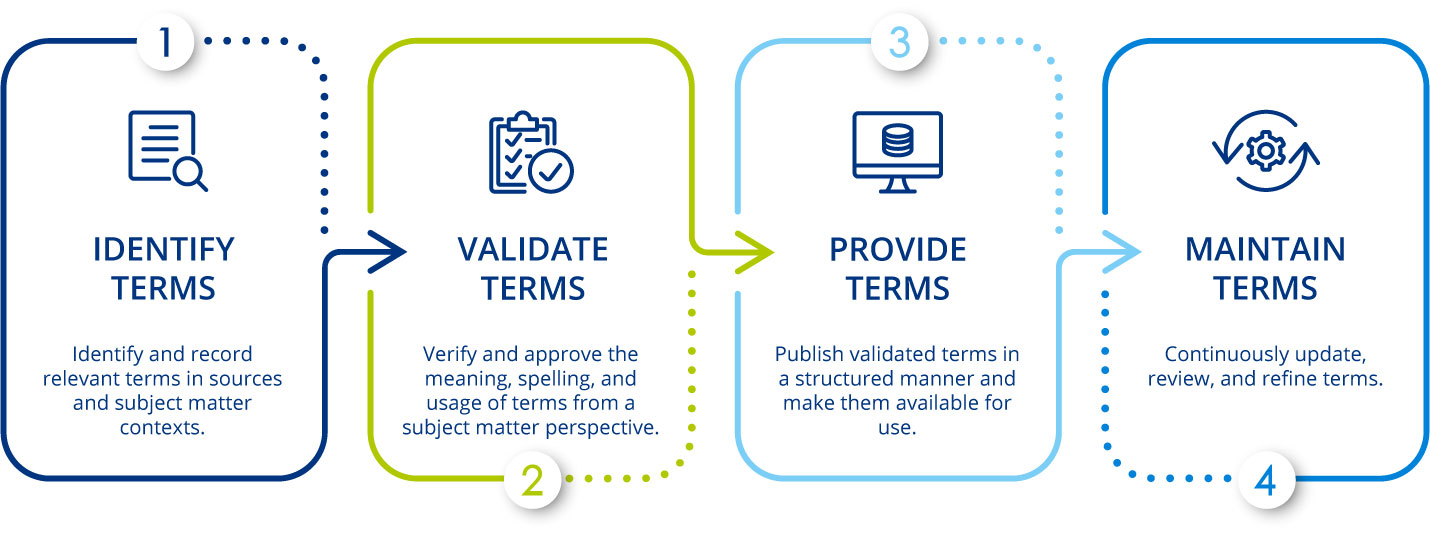
1. Identify terminology
The foundation of any terminology database is a valid data set. Ideally, glossaries or other reference works for corporate and technical terms already exist. In many companies, however, term lists or authoritative and comprehensive sources are lacking.
This is where AI can help and significantly speed up term extraction.Retrieval-Augmented Generation (RAG) is a method in which language models gain access to internal corporate knowledge repositories—such as documentation, specifications, or manuals—in addition to universally available datasets. Internal company data is vectorized, indexed, and embedded in context. The advantage: The query is combined with up-to-date information from the company’s own documents, leading to more precise results tailored to the company’s context.
2. Validate terminology
Term extraction yields valuable suggestions for technical terms and definitions. However, the use of RAG and AI methods does not replace expert review. In the “Term Validation” step, terminologists work with subject matter experts to evaluate the terms in terms of their relevance, unambiguity, and correct usage within the company’s context. Preferred terms, definitions, and synonyms are then established, and the terms are approved for further use.
This creates a reliable terminology foundation for consistent communication and successful integration into other AI applications.
3. Provide terminology
Terminology is most useful when it is available where employees create content, translate, or search for information. That is why the terminology database must be integrated into existing work environments and systems.
Many component content management, translation, or editorial systems feature built-in terminology functions. A real-world example: Arvato Systems uses the Smart Media Creator (SMC) for terminology management. This tool offers integrated terminology management functions and immediate access to terms during document creation, thereby ensuring consistent usage.
The integration of terminology databases into in-house AI solutions is also becoming increasingly important. A new approach is what is known as Terminology-Augmented Generation (TAG). In this approach , information from a terminology database is specifically integrated into the search query or the context of a language model. This allows the model to access approved technical terms and definitions while simultaneously avoiding blocked or undesirable terminology. This ensures consistency, technical accuracy, and uniform brand communication, while also reducing the risk of hallucinations.
4. Maintain Terminology
A terminology database is only of lasting value if it is continuously maintained and updated. New products, features, technologies, and business processes regularly lead to new technical terms or adjustments to existing terminology. As part of terminology maintenance, terminology managers add terms and definitions, remove duplicates, and manage approval statuses.
In addition to ongoing updates, the focus is on imparting terminology knowledge and guidelines. Practical training, guidelines, and best-practice examples help establish terminology as an integral part of daily work. Close collaboration with subject matter experts increases acceptance and ensures that terms remain technically accurate, understandable, and practical.
Conclusion: Small Terms, Big Impact
In an AI-driven workplace, consistent technical terminology determines the quality of documentation, translation, and AI outputs. Precisely because content is now being created, processed, and translated automatically on an ever-larger scale, the importance of clearly defined technical terms is increasing.
Terminology management lays the foundation for ensuring that information is understood and used consistently throughout the company. It reduces misunderstandings, improves the quality of documentation and translations, and supports the reliable use of AI applications.
Those who view terminology not as an isolated linguistic issue but as part of knowledge management create a solid foundation for efficient processes, consistent communication, and the future use of AI.
Frequently Asked Questions About Terminology Management
-
What is the difference between RAG and TAG?
RAG (Retrieval-Augmented Generation) extracts term candidates and definitions from existing documents and enriches AI responses with this content. TAG (Terminology-Augmented Generation), on the other hand, specifically accesses an approved terminology database and ensures that the language model uses only verified technical terms and avoids negative terms.
-
Who is responsible for terminology management at the company?
Terminology management is usually a cross-functional task. Companies often assign it to the technical writing department, product management, or corporate communications. Clear governance with defined responsibilities is crucial—supplemented by subject matter experts who ensure technical accuracy.
-
Why is terminology management important for AI applications?
AI applications can only deliver reliable results if terms are clearly defined and used consistently. A well-maintained terminology database reduces hallucinations, increases technical accuracy, and ensures consistent brand and technical communication.
Written by

Maika Hohlbein heads the Technical Documentation department. Drawing on her expertise in the IT and automotive industries, as well as her background in multilingual communication, she raises awareness of the challenges posed by multilingual projects and drives the optimization of documentation processes.