

Building an AI Platform with Databricks
The Foundation for Productive AI Agents
Many companies have AI and generative AI have already been successfully tested. Chatbots, assistants, and the first AI agents demonstrate the potential of these technologies.
The real challenge, however, begins when successful pilot projects are to be transformed into productive enterprise AI solutions. What works in a controlled demo must be operated safely, cost-effectively, and scalably in everyday business operations. Neither a powerful model nor a good prompt is sufficient for this. Companies need an AI platform that data, Governance, and AI are united on a common foundation.
What Is an AI Platform?
An AI platform provides the technical foundation for developing, testing, deploying, and continuously operating AI applications and agents. It integrates enterprise data, AI models, governance, permissions, and operational processes on a common foundation.
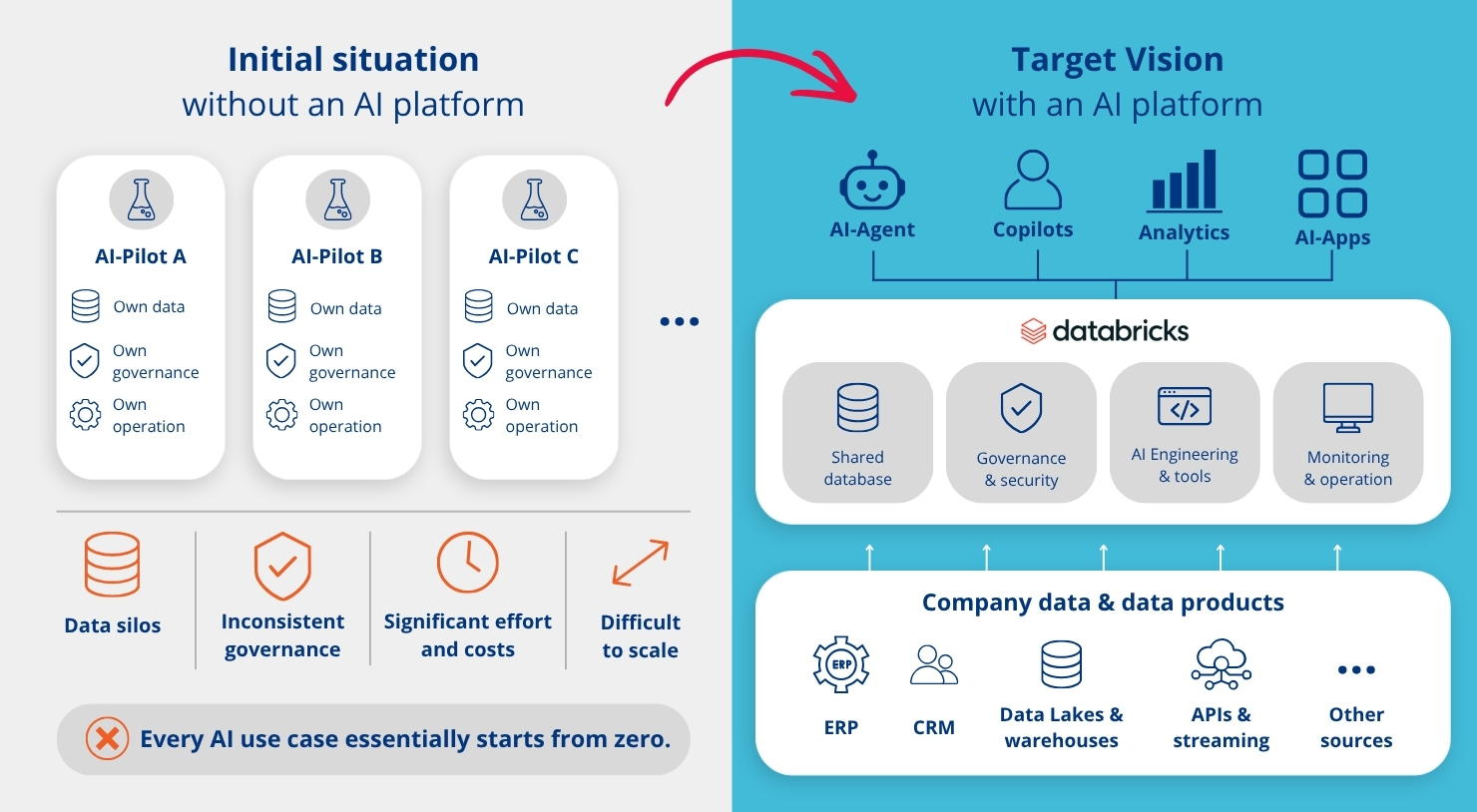
Unlike individual AI tools or isolated pilot projects, an AI platform is designed for repeatable, enterprise-wide use. This means that data access, security requirements, quality controls, and monitoring do not have to be completely rebuilt from scratch for every new use case.
A modern AI platform thus also lays the foundation for secure self-service. Business units can independently develop and use analytics and AI applications, while IT establishes central standards for security, data access, governance, and compliance. Innovation and control are not treated as opposites, but are integrated on a shared platform.
Why Isn’t a Good Language Model Alone Enough?
AI projects rarely fail because of the chosen LLM (Large Language Model). While it matters whether GPT, Claude, Gemini, or a specialized open-source model is used, the real challenges lie in the foundation:
- Data Access: Corporate data is distributed across SAP, data lakes, data warehouses, and line-of-business applications.
- Governance: Permissions, lineage, and quality rules are often not defined consistently.
- Business Context: AI agents require domain-specific definitions, roles, and processes to be able to correctly contextualize decisions.
- Operating model: Cost control, monitoring, and responsibilities are often not yet adequately regulated.
- Scaling: Each new AI use case is built individually, rather than being developed on a shared platform.
Rebuilding these foundations from scratch for every single AI use case is neither cost-effective nor scalable. When teams develop their own data copies, prompt logic, authorization models, and monitoring approaches, isolated solutions quickly emerge. What initially appears flexible leads, in the long run, to a fragmented AI landscape with higher operational costs and greater risks.
How Does Databricks Help Build an AI Platform?
Databricks addresses this platform issue with an approach that integrates data and AI platforms. As a result, AI applications are not developed alongside the data platform, but are built directly on top of it.
-
Lakehouse Architecture as the Foundation
The foundation is the Lakehouse architecture. It brings together data engineering, analytics, data science, machine learning, and generative AI on a shared data foundation. As a result, AI agents access the same data, definitions, and business context as reporting, planning, and operational applications. This reduces data duplication and inconsistencies, and new AI use cases can be implemented much more quickly.
-
Governance with the Unity Catalog
With the Unity Catalog, Databricks also provides a centralized governance layer for data and AI. Permissions, discovery, lineage, quality rules, and AI governance are integral parts of the platform and apply to all workloads. This ensures that companies retain control at all times over which
-
Built-in Features
The platform is complemented by integrated features for developing, evaluating, deploying, and operating AI applications and agents. At the same time, Databricks remains open to existing enterprise environments and integrates data from SAP, cloud, and other source systems without creating new data silos.
-
Further Development of Databricks
A recent example of the further development of Databricks in the context of Agentic AI is Omnigent. Databricks describes Omnigent as a meta-harness for agents. Simply put, Omnigent sits on top of existing agents and agent tools such as Claude Code, Codex, Cursor, Pi, or custom agents. It is designed to help combine agents, control them via policies, and use them together in sessions.
It’s important to put this into context: Omnigent on Databricks is currently in beta. So it shouldn’t be presented as a complete solution to all enterprise AI challenges. Omnigent is particularly exciting as a sign of things to come. The future lies not in individual agents, but in controlled agent landscapes that work together and are embedded within a governance framework.
What Are the Benefits of an AI Platform Powered by Databricks?
- Faster implementation of new AI use cases, because data, governance, and AI are brought together on a single platform.
- Secure self-service for business units, so that analytics and AI applications can be developed independently without compromising central governance.
- Scalable AI agents that access consistent enterprise data and thereby deliver reliable results for business units and business processes.
Economic value is not created by having as many separate AI projects as possible. What matters is an AI platform on which new applications can be efficiently developed, operated in a controlled manner, and continuously expanded.
Would you like to deploy AI applications and AI agents in your company in a secure, productive, and scalable way?
Our data and AI experts will help you build an AI platform with Databricks and integrate it into your existing cloud, SAP, data, and system landscape. Talk to us about how you can turn successful AI pilots into a solid foundation for enterprise-wide AI.
Written by

Dominik Lech is a Senior Data Engineer at Arvato Systems and designs modern data landscapes, from architecture through to operations. His areas of expertise include scalable data platforms, Data Mesh, Databricks, and AI in data engineering. He combines technical depth with strategic insight and a clear eye for actionable solutions.