

Headless and Composable CMS Solutions
Why they've really made It now
Digital Architecture in Transition
Ten years ago, the world of content management systems was relatively well-defined. A traditional CMS delivered content, managed pages, controlled templates, and was closely integrated with the front end. For many companies, this model worked well for a long time. Even today, this can still be a worthwhile approach. However, many systems are becoming more complex. When content is no longer intended to appear only on a website but also in apps, portals, and POS systems, a composable architecture may be the right approach.
What Is a Composable CMS?
A Composable CMS is a content management system that does not function as a rigid, all-in-one package, but rather as a modular building block within a digital architecture.
In short: Content is managed centrally but can be flexibly distributed to various channels and systems via interfaces—for example, websites, customer portals, apps, online stores, newsletters, or POS systems.
The difference from a traditional CMS:
Classic CMS
Content, presentation, and delivery are often closely linked.
Headless CMS
The CMS manages content, while a separate front end handles the presentation.
Composable CMS
It goes one step further: The CMS is part of a flexible, modular system architecture in which various specialized solutions work together via interfaces.
In this article, I'd like to use a client project as an example to show what a project like this might look like in practice.
Customer Requirements in a Real-World Example
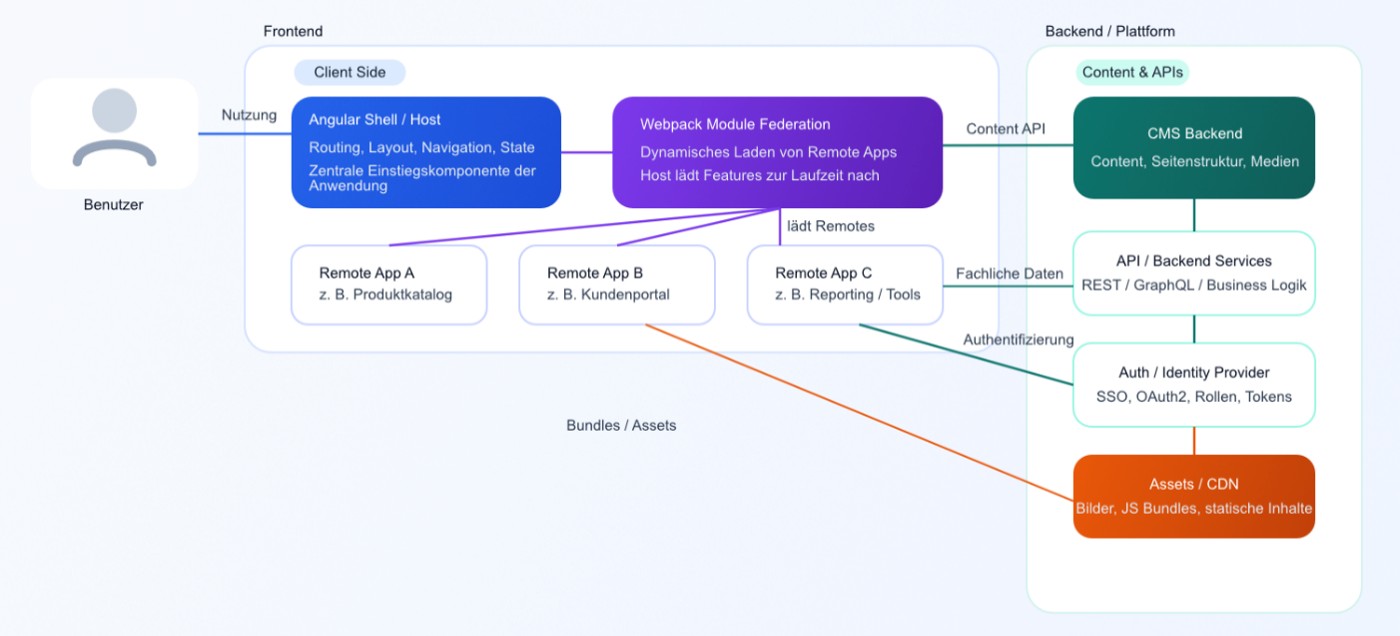
At our client's site Primeo Energie, it’s not just about providing a website. It was also about preparing content so that it would be available for the company’s own customer portal. Different teams are working on the fully integrated customer portal and the website. This makes a composable architecture particularly well-suited. Teams can deploy their applications independently of one another and access specific content via standardized interfaces. Various technologies are used to enable this type of architecture:
Magnolia CMS as a bridge between content and modern architecture
Magnolia has long positioned itself as a powerful solution for companies with growing digital needs—one that scales with them—and is now benefiting greatly from the fact that the market as a whole has matured.
Magnolia’s strength lies above all in the fact that the system does not think in rigid categories. It combines the strengths of a traditional CMS with modern headless capabilities. This makes Magnolia a platform that doesn’t force companies into a dogmatic architecture, but instead allows them to choose the right level of maturity for their digital strategy.
This flexibility also allowed our customers to switch back and forth between traditional and composable approaches, or even combine the two, while still working within a single CMS.
Angular as a Reliable Partner in Front-End Development
When it comes to stable front-end architectures, Angular continues to play a major role in many enterprise scenarios. While the JavaScript ecosystem has long been dominated primarily by speed, hype, and constant change, Angular has always been more synonymous with structure, consistency, and maintainability. Angular is not a cutting-edge framework, but it does offer a high degree of stability.
That is exactly why Angular is an excellent fit for headless and composable CMS solutions in a professional setting.
Clear architecture, strong typing, defined conventions, and good testability help not only to build complexity but also to manage it over the long term.
When combined with a headless CMS such as Magnolia, this results in a powerful separation of responsibilities. The CMS manages content and structures, while Angular handles the flexible, high-performance, and modern front-end rendering.
Module Federation as a Technological Extension
Module Federation expands this approach to include a crucial architectural capability. Individual sections of an application can be developed, tested, and deployed independently of one another. This means that the teams working on the Primeo customer portal no longer have to wait for a shared release cycle; instead, they can continue developing their features independently without disrupting the overall platform.
Module Federation thus clearly demonstrates that composability should not be considered solely at the level of backend systems or content. The concept of modularity can also be consistently applied to the front end. Angular provides the stable foundation for this, and Module Federation offers the appropriate technological extension.
“Composable” Does Not Mean “Arbitrary”
One of the biggest concerns about composable architectures remains to this day: If everything can be combined, doesn't that mean everything becomes arbitrary?
This concern is understandable. In fact, Composable can quickly become confusing if technical decisions are made without a strategic framework. But this is precisely where we see how far the market has come.
Today, "composable" means less and less about putting together as many building blocks as possible, and more and more about orchestrating systems in a targeted way:
- with clearly defined roles for individual systems
- with defined interfaces
- with reusable services
- with robust business models
- with an understanding of architecture that prioritizes sustainability over short-term gains
The implication is clear: composable solutions are becoming easier to manage. They are no longer automatically fragile or experimental; in many cases, they are attractive precisely because they can adapt to change better than monolithic systems.
Conclusion: The Future Is Not Only Flexible, but Also Intelligent and Stable
Headless and composable CMS solutions have long since become more than just a technology trend. They are evolving into a robust architectural model for companies that want to design consistent, future-proof digital experiences across multiple channels.
With Magnolia CMS as a powerful content platform, Angular as a robust front-end framework, and artificial intelligence as an additional accelerator, the result is a combination that meets modern requirements: modular, integrable, scalable, intelligent, and, above all, increasingly stable.



Written by

Marvin Kerkhoff has been working as a web developer since 2004. He began working at Arvato Systems Switzerland in 2010. He earned his Magnolia CMS certification in 2010 and achieved the highest level of Magnolia CMS certification in 2020. He has in-depth knowledge of comprehensive e-commerce and digital business projects with a variety of clients.