


IFRS 18: Effects on ERP Systems and Financial Processes
SAP Group Reporting supports with smart features
With IFRS 18, the IASB is adopting one of the most significant reforms to financial reporting in years. The new standard replaces IAS 1 and comes into force on January 1, 2027. The aim is to improve the informative value and comparability of financial statements. The finance and accounting departments of groups reporting in accordance with IFRS should deal with possible adjustments in a timely manner.
IFRS 18: Overview of the New Accounting Standard
IFRS 18 "Presentation and Disclosure in Financial Statements" is the result of the IASB's long-standing "Primary Financial Statements" project. The aim is to sustainably enhance the presentation of financial information, enabling companies to present their financial performance to investors and other stakeholders more understandably and comparably.
The new IFRS standard comes into force for financial years from January 1, 2027. Companies must adjust the comparative period retrospectively; this is a clear indication of how significant the IASB considers this change to be. The implementation of IFRS 18 is not just a ReWe issue - it also affects controlling/MGMT accounting, investor relations, and IT processes.
Until now, corporate financial reporting has been characterized by a lack of methodological transparency due to the use of specially defined key figures, such as “operating EBIT(DA)”.
With this in mind, the IASB has formulated three key objectives for IFRS 18:
- Improved comparability of financial statements across sectors
- More transparency through clearly defined categories
- Strong discipline in the use of company-specific key performance indicators
IFRS 18: Changes at a Glance
1. New structure of the income statement
IFRS 18 introduces three defined categories:
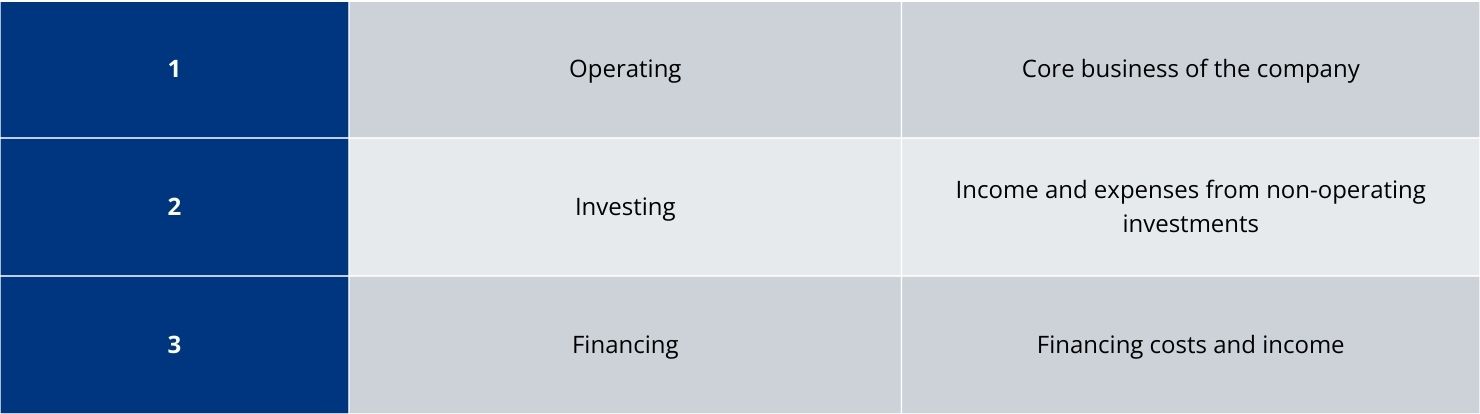
This separation is primarily based on the structure of the cash flow statement (IAS 7). It is intended to reflect economic reality more clearly, thereby increasing comparability within the peer group and across sectors. The categories "Income taxes" and "Discontinued operations" are still to be reported.
2. Management-defined performance measures (MPMs)
Companies often use their own performance measures that are not defined by IFRS – so-called "non-gap KPIs". IFRS 18 now requires the disclosure of these MPMs, including a reconciliation with the key performance indicators required by IFRS.
3. More details through disaggregation
The standard requires a more detailed breakdown of earnings items, e.g., for "other operating expenses". The aim is to increase the informative value of reporting and avoid "black boxes".
Challenges for the CFO Function
First practical experience shows that a considerable conversion effort can accompany the introduction of IFRS 18. User companies are well advised to deal with areas of action and measures at an early stage, e.g., in the following areas:
- ERP and consolidation systems (e.g., SAP S/4HANA, SAP Group Reporting)
- Reporting processes (Record-2-Report), KPIs/dashboards, and reporting layouts
- Investor relations and communication with analysts and banks
- Training requirements for accounting and controlling teams
Involvement of the auditor
Before the project starts, an impact assessment can help to identify the affected processes, systems, and reporting elements. Pro forma conclusions may offer valuable insights into any adjustments that have not been implemented.
Technically, it must be ensured that the new categories and MPMs can be mapped. In terms of content, it must be analyzed which P&L items need to be recategorized and what effects there are on KPIs, covenants, and internal control parameters.
The finance department typically needs to revise the existing chart of accounts (including the chart of accounts and report layout) to meet the new requirements for presenting the income statement and fulfilling disclosure obligations. The focus is usually on the disaggregation of "collective items", e.g., "Other operating expenses". In addition to retrospective application, reconciliations, which clearly show the changes compared to IAS 1, also drive the implementation effort.
Changes to the Cash Flow Statement
There are two main changes to the cash flow statement:
- The "operating profit or loss" is defined as the starting point for determining the operating cash flow.
- The current options for the presentation of interest/dividends paid and received are clarified: In the future, for companies without specific main business activities, interest and dividends paid are to be shown in cash flow from financing activities, while interest and dividends received are to be shown in cash flow from investing activities.
Concrete Measures for IFRS 18 Preparation in UCT Format
Assignment to new categories
IFRS 18 requires the income statement to be divided into "Operating", "Investing" and "Financing". Items typical of the UKV such as "Cost of sales" or "Distribution costs" must be allocated to these categories.
Evaluation of functional areas
Check whether individual cost types (e.g. R&D, sales, administration) can be clearly assigned to the operational area or whether further disaggregation is necessary.
Annex reconciliation
In future, a separate disclosure will be required in the notes, showing the main expenses for the respective functional areas broken down by cost type (e.g. personnel, depreciation).
Modern SAP EPM Tools Support the Transformation
This is how SAP Group Reporting for SAP S/4HANA is set up to enable companies to comply with IFRS 18 and simplify the creation of new accounts and subtotals, for example. User companies can already optimize their financial reporting processes and adapt to future standard changes without having to carry out extensive reconfigurations:
- Set up of Consolidation Extension Versions: This functionality provides a robust and future-proof framework for managing parallel financial reports and restatements.
- Consolidation Chart of Accounts Updates: This feature facilitates the updating and maintenance of changes in the Chart of Group Positions and thus ensures compliance with the newly defined requirements for the disclosure of financial information.
- Mapping with ERP chart of accounts: SAP Group Reporting facilitates and automates the mapping between ERP chart of accounts and Group Chart of Positions.
- Time-dependent FS item hierarchy maintenance: The system supports the maintenance of time-dependent FS item hierarchies, enabling continuous updates over time.
- Group Reporting Data Collection: Organizations can collect additional information required to comply with IFRS 18 (e.g., reporting expense items to determine adjusted EBITDA).
Consolidation Monitor (New Version): It is possible to open and close several financial years for several consolidation groups (scopes) with one click.
The flexibility and scalability of SAP Group Reporting in "Best Practice 1SG" is being further expanded through ongoing development:
- New structured income statement: The chart of positions is expanded, and the consolidated income statement is restructured to comply with the presentation requirements of IFRS 18.
- Update of the cash flow statement: The starting point of the consolidated cash flow statement is updated so that the subtotal of the operating result serves as the starting point.


Written by

Prof. Dr. Martin Wünsch is an expert in financial reporting and SAP S/4Hana Finance Consulting. He is familiar with this field from various perspectives, e.g., Big4-Audit, Corporate Functions, or Management Consulting. He holds a chair in Business Administration, in particular in Int, Accounting & Controlling, at the FOM University of Applied Sciences Düsseldorf and regularly publishes on current topics in financial reporting.